
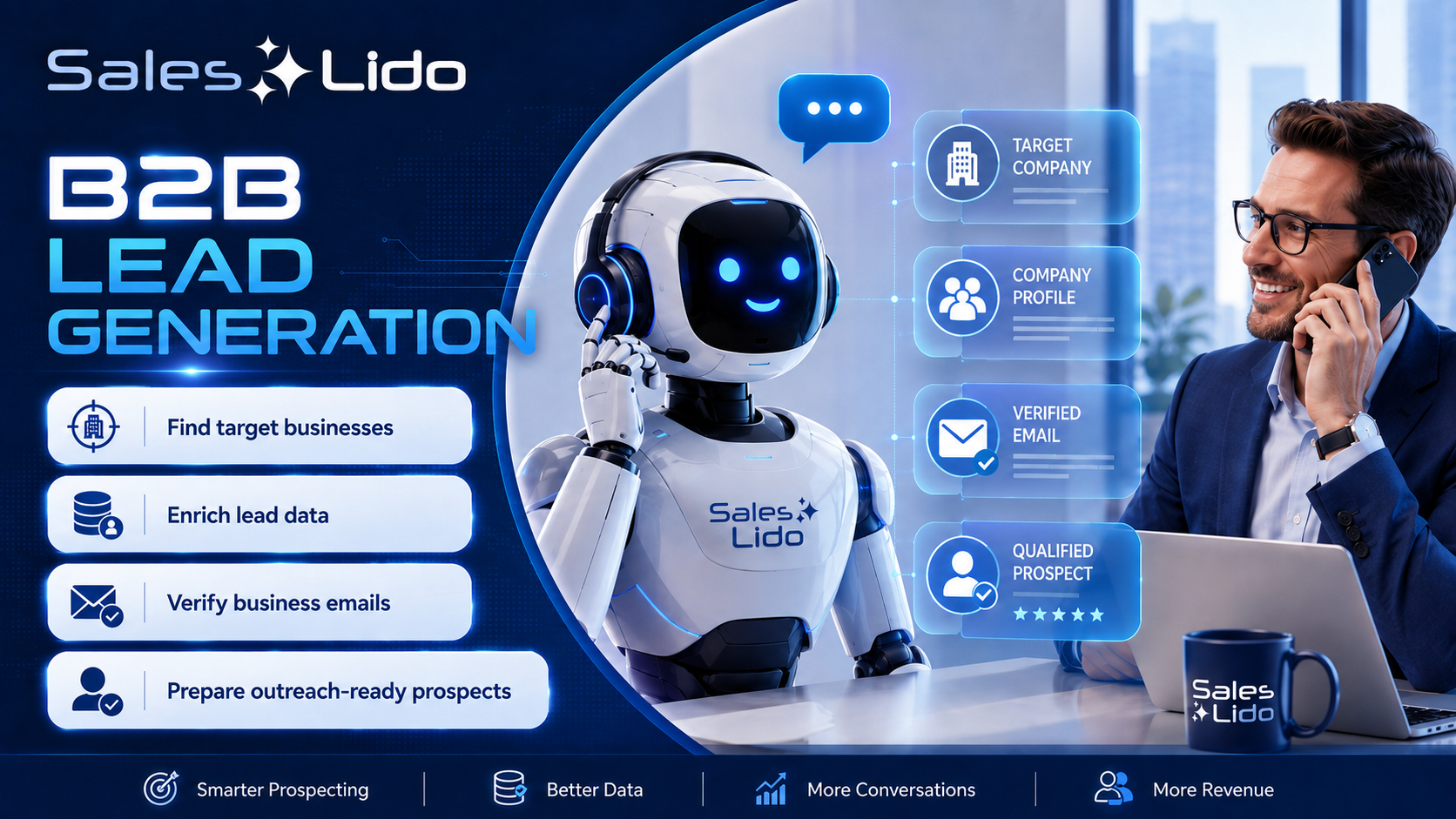
B2B Lead Generation
The Complete Guide to B2B Lead Generation
Learn how to find the right businesses, build cleaner prospect lists, identify usable email addresses and prepare better leads for personalised B2B outreach.
15 min read • Updated 17 August 2026
B2B lead generation is often treated as a numbers game: collect as many company names and email addresses as possible, load them into an outreach tool and start sending.
That approach usually creates more problems than opportunities.
Good B2B lead generation is not about building the biggest database. It is about consistently identifying businesses that are genuinely relevant to what you sell, collecting enough reliable information to understand them, finding usable contact details and preparing those prospects for meaningful outreach.
A list of 500 carefully selected prospects can be far more commercially useful than 50,000 businesses collected without a clear reason for contacting them.
In this guide, we’ll build the complete process from target market to outreach-ready prospect.
📘 In This Guide
You’ll learn how to:
✓ Define the businesses you actually want to reach
✓ Find companies that match your ideal customer profile
✓ Collect and enrich useful prospect data
✓ Find and verify business email addresses
✓ Research, qualify and prioritise prospects
✓ Prepare clean lead data for personalised cold email
⏱ Reading Time
15 minutes
🎯 Best For
Business owners, founders and B2B sales teams
What Is B2B Lead Generation?
B2B lead generation is the process of identifying businesses that could benefit from your product or service and preparing them to enter your sales process.
That definition is deliberately broader than simply finding an email address.
A useful lead-generation process answers several questions before outreach begins:
- Is this business genuinely relevant to what we sell?
- Does it fit our target market?
- Do we know enough about the business to contact it intelligently?
- Do we have a usable business email address?
- Is the contact data sufficiently accurate to use safely?
- Is there a sensible reason for beginning a conversation?
If those questions cannot be answered, you may have data, but you do not necessarily have a good sales lead.
B2B Leads vs B2C Leads
Business-to-business prospecting differs from consumer lead generation because the potential customer is an organisation rather than simply an individual buyer.
This changes the information you need.
| B2C Lead Generation | B2B Lead Generation |
|---|---|
| Focuses on individual consumers | Focuses on businesses and organisations |
| Often driven by personal interests or demographics | Often driven by sector, location, company type and commercial need |
| Shorter purchase decisions are common | Several conversations or decision stages may be involved |
| Personal contact data may be central | Company information and business contact data are central |
| High-volume advertising is common | Targeted prospecting can be more valuable than raw volume |
In B2B outreach, understanding the company is often just as important as knowing the person you intend to contact.
What Makes a Good B2B Lead?
A good B2B lead is not simply a company with an email address.
It is a business that matches your targeting criteria, appears capable of benefiting from what you offer and can be approached through reliable contact information.
Strong leads normally combine four things:
- Fit: the company matches the type of customer you want.
- Relevance: there is a believable connection between its situation and your offer.
- Contactability: you have a usable way to reach the business.
- Context: you know enough to make the approach sensible rather than generic.
🤖 Lido Tip
Do not begin by asking, “How many leads can we find?”
Start with, “Which businesses would we genuinely be pleased to receive a reply from?”
That simple change moves lead generation away from database building and towards opportunity building.
Define Your Ideal Customer Profile
Your Ideal Customer Profile, or ICP, describes the type of business most likely to be a strong fit for what you sell.
It gives your prospecting process boundaries.
An ICP might include:
- Industry or sector
- Geographic area
- Business type
- Company size
- Likely commercial need
- Typical customer base
- Products or services offered
- Characteristics that make your solution especially relevant
For example, “small businesses” is usually too broad to be useful.
“Independent commercial cleaning companies serving offices in Greater Manchester” gives you a much clearer prospecting target.
The more clearly you define the market, the easier it becomes to decide whether a company belongs in your campaign.
Define Your Target Market
Your ICP describes the type of customer you want. Your target market turns that profile into a searchable group of businesses.
Useful targeting variables include sector, location, business model, services, company characteristics and evidence of a particular need.
Instead of trying to search the entire market at once, break it into specific prospect groups.
Identify Prospect Types
One product may have several legitimate prospect types.
A commercial welding contractor, for example, might target fabrication companies, engineering firms, construction contractors and industrial maintenance businesses. Those prospects have similarities, but the reason for contacting each group may differ.
Treating them as separate segments gives you better data and makes later personalisation much easier.
Finding Businesses That Match Your ICP
Once the targeting criteria are clear, business discovery becomes a filtering exercise rather than a guessing exercise.
Your objective is to identify real companies that satisfy enough of your criteria to justify further research.
Potential sources include business directories, search engines, company websites, industry directories, trade associations, public business listings and specialist prospecting platforms.
The source matters less than the discipline applied afterwards. A company should not automatically enter your outreach campaign simply because it appeared in a search result.
Discovery should create a pool of possible prospects. Qualification decides which of them deserve attention.
What Prospect Data Should You Collect?
Collect enough information to support targeting, research, personalisation and safe outreach, but avoid gathering data simply because it is available.
| Data | Why It Matters |
|---|---|
| Business name | Identifies the prospect and supports personalisation |
| Website | Provides a primary source for company research |
| Location | Helps confirm geographic fit |
| Sector or business type | Supports qualification and segmentation |
| Business email | Provides the contact channel for outreach |
| Products or services | Helps identify relevant outreach angles |
| Company context | Supports more meaningful personalisation |
| Email verification status | Helps reduce avoidable bounces |
The goal is not to create the most detailed company record possible. It is to collect the information needed to make a better prospecting decision.
Business Websites and Company Information
A prospect’s own website is often one of the most useful sources of context.
It can tell you what the business sells, who it serves, where it operates and how it describes its own value proposition.
This information can also expose bad targeting.
If your search identifies a company as a manufacturer but its website shows that it is actually a consultancy, that lead may need to be removed or moved into a different segment.
Good lead generation allows new information to refine the list rather than treating the initial search result as unquestionable.
Finding Business Email Addresses
Finding the company is only half the job. For email outreach, you also need a usable business email address.
Depending on the company, this may be a named business address or an appropriate role-based mailbox.
The important distinction is between finding an address and finding an address you can reasonably use.
An email discovered from a company website, public business source or email-discovery process should still be treated as a candidate until it has been checked.
Email Verification
Email verification checks whether an address appears suitable for sending before it enters your outreach queue.
This matters because poor lead data does not only waste sales activity. It can affect deliverability.
Repeatedly sending to invalid addresses creates bounces. High bounce rates are a warning sign that your prospecting process is not sufficiently controlled.
Verification is therefore part of lead quality, not merely an administrative step at the end.
A sensible workflow is:
Discover business → find candidate email → verify address → approve usable contact → prepare for outreach.
Lead Enrichment
Lead enrichment means adding useful information to a basic prospect record.
You may begin with little more than a company name and website. Enrichment can add sector, location, services, email information and other company context.
The value of enrichment is not the number of additional fields created. Its value is the increased ability to make decisions.
Useful enrichment should help you answer questions such as:
- Does this business actually match the campaign?
- What does it appear to care about?
- Which part of our offer is most relevant?
- Can we contact it safely?
- Should this prospect be prioritised?
Prospect Research
Enrichment structures the record. Prospect research tries to understand the business.
That distinction becomes increasingly important when you want to personalise outreach.
Useful research might identify what the business does, who it serves, its commercial focus, relevant services, recent information available on its website or obvious reasons your offer may be useful.
You do not need to write a company biography before sending an email.
The aim is to find enough genuine context to make the message relevant.
Lead Qualification
Qualification is the point where you decide whether a discovered business deserves to become an active sales prospect.
A simple qualification framework can consider:
- Fit: does it match the ICP?
- Need: is there a credible reason your offer may be useful?
- Contact quality: do you have a usable email address?
- Context: can you understand enough about the business to contact it intelligently?
- Priority: is it worth contacting now?
Qualification prevents every discovered company from being treated equally.
Lead Scoring and Prioritisation
If you have more prospects than you can reasonably contact at once, lead scoring helps establish an order.
You might assign more weight to businesses that closely match your ICP, have verified contact details, show strong relevance to your offer or fit a particularly valuable segment.
The scoring system does not need to be complicated.
Even simple classifications such as high priority, standard and low confidence can stop the strongest prospects disappearing into a large database.
Segmenting Prospect Lists
Segmentation groups similar prospects together so they can be approached with more relevant messaging.
You might segment by industry, location, service type, company characteristic or campaign objective.
For example, a software company could technically place accountants, recruitment firms and estate agencies into one “small business” list. But each group operates differently and may respond to different problems.
Separate segments allow your campaign context to reflect those differences.
Cleaning Lead Data
Before prospects reach your email campaign, clean the data.
Lead cleaning can include removing duplicates, correcting obvious formatting problems, excluding companies that no longer fit the campaign, checking websites, resolving missing fields and removing email addresses that failed verification.
This step becomes particularly important when leads have been gathered from several sources.
A clean list gives the rest of your outbound system a better foundation.
Preparing Leads for Cold Email
An outreach-ready lead should contain more than a destination address.
Before a prospect enters a cold email sequence, you should ideally know:
- Who the business is
- Why it belongs in the campaign
- What relevant context has been discovered
- Which email address should be used
- Whether that address has been verified
- Which campaign or segment the prospect belongs to
- What broad outreach angle makes sense
This creates an important boundary between lead generation and cold email.
Lead generation decides who is worth contacting and what we know about them. Cold email strategy decides how to begin the conversation.
How Automation Changes B2B Prospecting
Manual prospecting works, but it becomes repetitive quickly.
Automation can help discover businesses, enrich basic records, identify candidate email addresses, verify contact data, research prospects and organise leads into campaign workflows.
The danger is assuming automation should maximise the number of leads collected.
It should not.
The best use of automation is to apply a consistent process to more prospects without abandoning quality controls.
In other words:
Automation should make good prospecting more repeatable, not make indiscriminate prospecting faster.
🚀 Lido in Action
A traditional prospecting workflow can involve jumping between business directories, websites, spreadsheets, email-finding tools, verification services and research notes before outreach even begins.
Sales Lido is designed to connect those stages into a single B2B email workflow.
Inside Sales Lido, the process can include:
✓ Discovering businesses within a defined target market
✓ Enriching prospect information
✓ Finding candidate business email addresses
✓ Verifying email addresses before outreach
✓ Researching individual prospects
✓ Generating relevant personalised cold email
✓ Moving qualified leads into automated email campaigns
The objective is not to create the largest list possible. It is to reduce the manual work between identifying a good market and starting a good sales conversation.
The Complete B2B Lead Generation Framework
The full process can be reduced to a practical sequence:
1. Define the market
Decide exactly which types of businesses you want to reach.
2. Discover prospects
Find companies that appear to match those criteria.
3. Enrich and verify
Add useful company information, identify email addresses and check the data.
4. Research and qualify
Understand each prospect well enough to decide whether it deserves outreach.
5. Prepare for the campaign
Segment, prioritise and pass clean prospect records into your cold email workflow.
Notice that sending the email does not appear until after all five stages.
That is deliberate. Better outreach starts with better prospect selection.
✅ B2B Lead Generation Checklist
Before moving prospects into a cold email campaign, check that you have:
✔ Defined a clear Ideal Customer Profile
✔ Chosen a specific target market
✔ Identified relevant businesses rather than simply collecting names
✔ Checked company websites and business information
✔ Collected useful prospect context
✔ Found an appropriate business email address
✔ Verified the email where possible
✔ Removed duplicates and poor-quality records
✔ Qualified the business against your campaign
✔ Segmented or prioritised the list where appropriate
✔ Prepared enough context to support relevant outreach
💡 Lido Tip: If you cannot explain why a particular business belongs in your campaign, it probably should not be there yet.
⚠ Common B2B Lead Generation Mistakes
Most poor prospect lists are created before the first email is ever written.
✗ Targeting an entire industry without defining the right type of business
✗ Collecting huge lists because the data is available
✗ Treating every discovered company as qualified
✗ Buying old or poorly matched databases
✗ Assuming an email address is valid without checking it
✗ Ignoring duplicate or incomplete records
✗ Researching prospects after the email has already been generated
✗ Using the same campaign context for very different prospect segments
✗ Prioritising lead quantity over commercial relevance
Lido Tip: A lead database is not an achievement by itself. Its value is measured by how many genuinely relevant conversations it can help create.
🤖 Copy & Use This Ai Prompt
Use this prompt to sharpen your targeting before you start collecting prospects.
Act as a B2B prospecting strategist.
My business sells: [PRODUCT OR SERVICE].
Our strongest existing customers are: [DESCRIBE THEM].
Help me create a practical Ideal Customer Profile for cold email prospecting.
Define:
• The best business types to target
• Relevant industries
• Useful geographic or company-size filters
• Signs that a company may need our offer
• Reasons a prospect should be excluded
• The business information I should collect before outreach
• Three logical prospect segments I could test separately
Prioritise relevance and lead quality rather than list size. Do not invent facts about individual prospects.
Frequently Asked Questions
What is the best way to generate B2B leads?
Start by defining a narrow Ideal Customer Profile, then find businesses that match it. Enrich and verify the data, research the strongest prospects and only move qualified companies into outreach. The best method is the one that consistently produces relevant, contactable prospects rather than simply large lists.
How many B2B leads do I need?
There is no universal number. The correct volume depends on your sales goals, conversion rates, sending capacity and market size. Start with a manageable group of well-qualified prospects and measure the results before increasing volume.
Is buying B2B lead lists a good idea?
Purchased databases can contain outdated, irrelevant or poorly matched information. Even when a list is legally usable, you should still qualify the businesses and verify contact data rather than assuming the entire database is suitable for outreach.
What is lead enrichment?
Lead enrichment is the process of adding useful information to a basic prospect record. This might include company details, website information, sector, location, business context and email data that help determine whether the prospect is relevant and how it should be approached.
Should I verify business email addresses?
Yes. Verification can help identify addresses that are more likely to be usable and reduce avoidable bounces. It should form part of your broader email deliverability process.
What is more important: lead quality or lead quantity?
Quality should come first. A smaller list of businesses that closely match your target market gives you a stronger basis for relevant outreach, cleaner campaign data and meaningful sales conversations.
Can Ai automate B2B lead generation?
Ai can assist with tasks such as prospect research, classification, enrichment, identifying outreach angles and organising context. It works best when combined with clear targeting rules and reliable source data rather than being asked to invent prospects or make unsupported assumptions.
When is a B2B lead ready for cold email?
A prospect is ready when it fits the campaign, has sufficient business context, has a usable contact address and gives you a credible reason to begin a conversation. Outreach should be the result of the qualification process, not the beginning of it.
🎯 Key Points
✓ B2B lead generation starts with targeting, not contact collection
✓ A smaller relevant list can be more valuable than a huge unqualified database
✓ Business information, email discovery and verification all contribute to lead quality
✓ Prospect research creates the context needed for relevant outreach
✓ Qualification and segmentation should happen before sending
✓ Automation should make a disciplined prospecting process more repeatable
Conclusion
B2B lead generation is the foundation of an effective outbound sales system.
If the wrong companies enter the top of the process, better email copy, smarter automation and more follow-ups cannot fully repair the problem.
Start with a clear picture of the businesses you want. Find companies that genuinely match that profile. Enrich the information, verify contact data, research the opportunity and qualify the prospect before asking your outreach system to do anything.
The principle is simple:
Find fewer random businesses. Find more of the right businesses.
Once those prospects are clean, understood and outreach-ready, they can move naturally into the next stages of the Sales Lido methodology: personalised cold email, controlled automation, safe delivery, intelligent follow-up and measurable sales conversations.
🚀 Turn Better Prospects Into Better Conversations
Sales Lido helps connect B2B prospecting with the outreach that follows.
Find targeted businesses, enrich prospect information, identify and verify email addresses, research each company and turn qualified leads into personalised automated cold email campaigns.
Instead of assembling a sales workflow from disconnected tools, Sales Lido is being built around one focused process: finding the right companies and turning them into real B2B email conversations.
You May Also Like…
- How to Build a B2B Prospect List
- How to Find Business Email Addresses
- What Is Lead Enrichment?
- How to Create an Ideal Customer Profile
- Lead Quality vs Lead Quantity
- How to Research B2B Prospects
- How Lead Enrichment Improves Cold Email Results
Build a Smarter B2B Outreach System
Get practical B2B lead generation, cold email, automation, deliverability and Ai sales intelligence tips delivered to your inbox.
Meta description: Learn how to generate better B2B leads, build targeted prospect lists, find and verify business emails, enrich lead data and prepare prospects for cold email.