
Cold Email
The Complete Guide to Cold Email
Learn how to find the right prospects, write better cold emails, automate follow-ups and build a repeatable B2B outreach system.
14 min read • Updated 7 August 2026
Cold email can be one of the most direct ways to start conversations with potential B2B customers.
But there is a big difference between sending cold email and running an effective cold email campaign.
Successful outreach is not about finding thousands of email addresses and sending the same message to everyone. It starts with choosing the right prospects, understanding why they might care, creating a relevant message and following up in a controlled, consistent way.
Get those foundations right and cold email becomes a repeatable sales process rather than a numbers game.
📘 In This Guide
In this guide you’ll learn:
✓ What cold email really is
✓ How to choose the right prospects
✓ How to structure an effective cold email
✓ How to personalise outreach at scale
✓ How to build a follow-up sequence
✓ How to automate cold email safely
✓ Which campaign metrics actually matter
⏱ Reading Time
14 minutes
🎯 Best For
Business owners and B2B sales teams
What Is Cold Email?
Cold email is a direct email sent to a person or business with whom you do not already have an established relationship.
In B2B sales, the purpose is normally to start a relevant business conversation rather than immediately make a sale.
That distinction matters.
A good cold email does not try to squeeze an entire sales presentation into someone’s inbox. It gives the recipient a reason to pay attention, explains why the conversation may be relevant and makes it easy to take a small next step.
Cold email is also different from traditional marketing email. Marketing campaigns are generally sent to people who have already subscribed, registered or otherwise entered a marketing audience. Cold email usually begins with targeted prospect research and direct B2B outreach.
The strongest campaigns therefore behave less like mass advertising and more like organised one-to-one prospecting.
🤖 Lido Tip
Do not begin by asking, “How many emails can we send?”
Begin by asking, “Who genuinely has a reason to receive this email?” Better targeting improves almost every part of a cold email campaign.
Why Cold Email Still Works
Business buyers have more ways to communicate than ever, but email remains useful because it is direct, asynchronous and easy to evaluate.
A prospect does not need to answer a telephone call or attend a meeting just to understand why you are contacting them. They can read your message when convenient and decide whether the conversation is relevant.
Cold email also gives businesses a level of control that is difficult to achieve with many other acquisition channels.
You can decide exactly which companies to target, which contacts to approach, what message to use, how often to follow up and which results to measure.
That makes cold email particularly useful for businesses with a clearly defined B2B customer profile.
However, cold email works best when relevance comes before volume. Sending more messages does not automatically create more opportunities. If targeting is poor or the message is generic, increasing volume simply allows you to make the same mistake faster.
Start With the Right Prospects
The quality of a cold email campaign is largely decided before the first email is written.
If your prospect list contains businesses that are unlikely to need what you sell, even excellent copy will struggle.
Start with an Ideal Customer Profile, often shortened to ICP. Your ICP describes the type of organisation most likely to benefit from your product or service.
Useful criteria might include industry, location, company size, business model, customer type, growth stage or a particular commercial problem.
For example, “small businesses” is far too broad. “Independent UK recruitment agencies with 5–25 employees that regularly need new employer clients” gives you something much more useful to work with.
Once the company profile is clear, identify the people most likely to care about your offer. Depending on what you sell, that could be the founder, sales director, operations manager, marketing lead or another relevant decision maker.
Finally, check the data before launching outreach. Incorrect or outdated email addresses create unnecessary bounces and waste campaign capacity. Good prospecting therefore includes both finding leads and validating whether the available contact information is usable.
The Seven-Step Cold Email Framework
A reliable cold email campaign can be broken into seven practical stages.
1. Define the campaign goal
Decide what you want the campaign to achieve before writing anything.
The goal might be to book a discovery call, start a conversation, offer a demonstration or simply find out whether there is interest.
Keep the first objective small. Cold prospects rarely need to make a major commitment after one email.
2. Build a targeted prospect list
Use your ICP to identify businesses that genuinely match the campaign.
Collect only the information you actually need, such as company name, website, contact name, role and business email address. Additional information can then be used to improve qualification and personalisation.
3. Research the reason to contact them
Good personalisation is based on relevance, not trivia.
Ask what you know about this business that makes your offer potentially useful. Their industry, services, customers, location, hiring activity, growth or positioning may give you a meaningful angle.
4. Write a short, focused first email
Your first email should quickly answer four questions:
Who are you?
Why are you contacting me?
Why might this matter?
What do you want me to do next?
Remove anything that does not help answer one of those questions.
5. Use a simple call to action
A cold email call to action should make replying easy.
Instead of immediately asking for a 60-minute meeting, consider a lower-friction question such as, “Worth a quick conversation?” or “Would it be useful if I sent a little more detail?”
6. Plan the follow-ups before launch
Do not treat follow-up as something you remember to do later.
Create the sequence before the campaign starts. Each follow-up should have a purpose: a reminder, a different angle, additional context or a polite closing message.
7. Measure, learn and improve
Every campaign gives you information.
If emails are being delivered but nobody is responding, the problem may be targeting, positioning or messaging. If many addresses bounce, review your lead data. If replies arrive but rarely become opportunities, look at qualification and the offer itself.
🚀 Lido in Action
The seven steps above describe the workflow behind effective cold email.
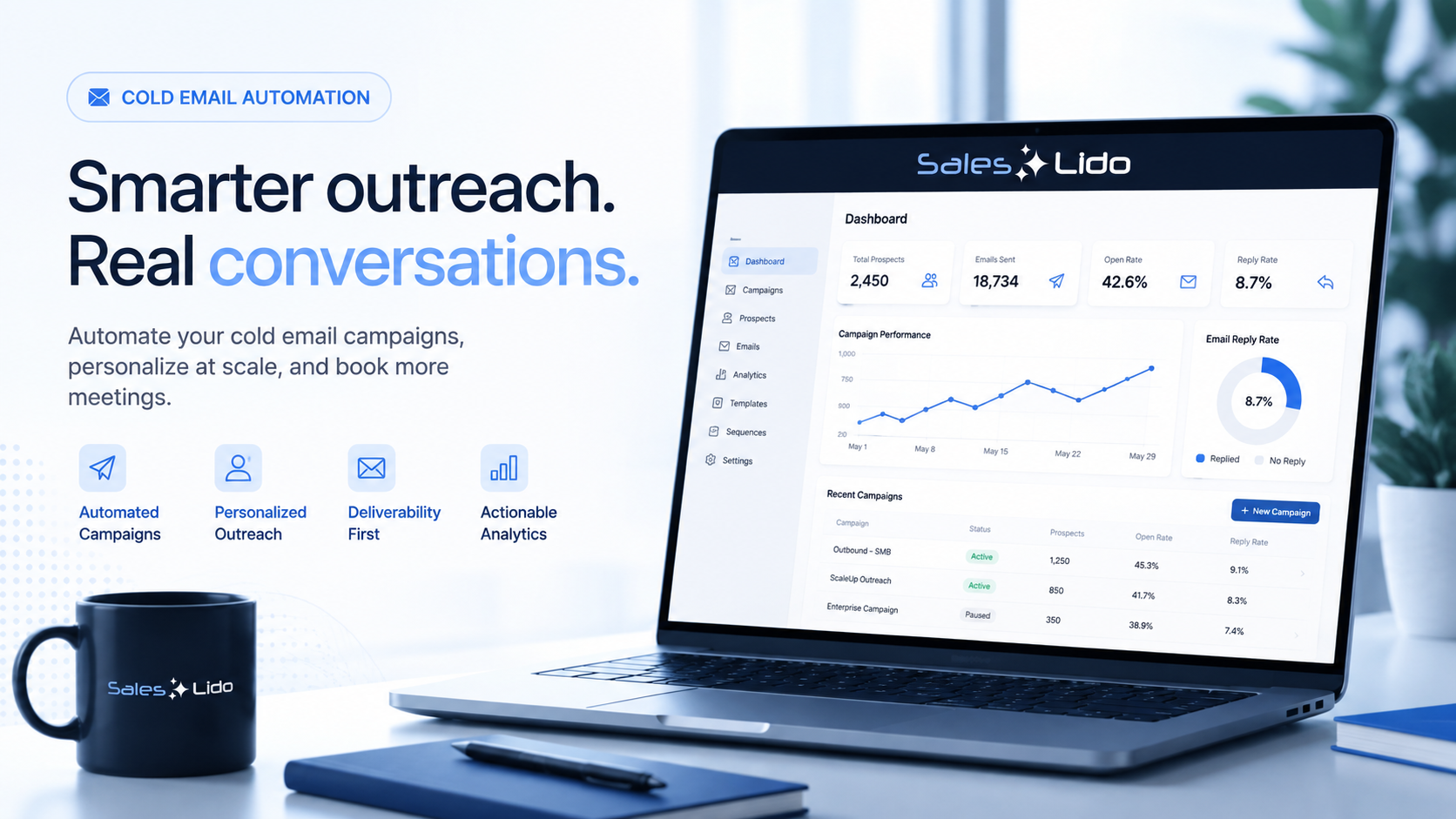
Sales Lido brings that workflow together by helping you find relevant businesses, enrich prospect data, identify usable business email addresses, create personalised outreach and run automated email campaigns from one system.
Inside Sales Lido you can:
✓ Build targeted prospect lists
✓ Enrich business lead data
✓ Create personalised cold emails with Ai
✓ Automate sending and follow-ups
✓ Control sending behaviour
✓ Track campaign performance and replies
How to Write a Cold Email That Gets Read
There is no single perfect cold email template, but strong emails normally share the same basic qualities: they are relevant, easy to understand and quick to read.
Use a straightforward subject line
Your subject line does not need to be clever. Its job is to make the email feel relevant enough to open without creating false expectations.
Simple subject lines based on the topic, company or business problem often work better than exaggerated promises designed purely to attract attention.
Get to the point quickly
A cold prospect does not know you yet, so avoid a long introduction about your company.
Start with the reason for contacting them. Show that the email has a purpose and that you understand something about their business.
Focus on the prospect, not your product
“We are a leading provider of…” is rarely the most interesting opening sentence for someone who has never heard of you.
Translate what you sell into the outcome that matters to the recipient. Instead of listing features, explain the business problem you help solve.
Make the next step easy
One email should normally contain one primary call to action.
If you ask someone to book a meeting, watch a video, download a document, visit three web pages and answer several questions, you create unnecessary friction.
Give them one clear decision.
Example cold email
Subject: New enquiries for Acme Engineering
Hi Sarah,
I came across Acme Engineering while looking at precision manufacturers in the Midlands.
We help specialist B2B firms build targeted prospect lists and run personalised outbound email campaigns without manually researching and following up with every lead.
If generating more conversations with UK manufacturers is a priority this quarter, would it be useful if I sent over a quick example of how the process could work for Acme?
Best,
James
The example is deliberately simple. It establishes relevance, explains the value clearly and ends with a low-friction next step.
Cold Email Personalisation That Actually Matters
Personalisation does not mean adding someone’s first name to a generic email.
Useful personalisation answers a more important question: why is this message relevant to this particular prospect?
You might personalise around the prospect’s industry, services, target customers, location, recent expansion, role or another meaningful business signal.
The best level of personalisation depends on the campaign. A highly valuable list of 50 prospects may justify deeper individual research. A broader campaign may use structured information about each business to create relevant variations efficiently.
This is where Ai can be useful. Prospect data can be analysed to identify relevant information and generate email copy around that information without requiring someone to manually write every message.
But automation should not invent facts.
If your system does not know something about the prospect, the email should not pretend that it does. Strong Ai personalisation depends on reliable source data and clear campaign instructions.
The goal is not to make every email look dramatically different. The goal is to make every email feel appropriately relevant.
How to Build a Cold Email Follow-Up Sequence
A lack of response to the first email does not necessarily mean the prospect is not interested.
They may have been busy, away from their desk or simply not ready to respond when the message arrived.
That is why follow-ups are an important part of cold outreach.
A useful sequence might contain an initial email followed by several carefully spaced follow-ups. There is no universal number or timing that works for every business, so the sequence should reflect your audience, offer and sending strategy.
Avoid sending the exact same message repeatedly.
Your first follow-up might simply bring the original email back to the prospect’s attention. The next could introduce another benefit, example or use case. A final message can politely close the sequence and give the recipient an easy opportunity to respond.
Most importantly, stop automated follow-ups when a prospect replies or when there is another clear reason to remove them from the sequence.
Automating Cold Email Without Losing Control
Automation is most valuable when it removes repetitive work without removing judgement from the campaign.
A well-designed automated workflow can move a prospect from research through personalisation, sending, follow-up and campaign tracking without somebody manually performing every step.
However, automation should not mean sending as quickly as possible.
Good systems need controls around sending schedules, intervals, daily volume and follow-up behaviour. They also need a clear response to events such as replies, failed delivery or campaign pauses.
Think of automation as consistency rather than speed.
The objective is to make sure the right prospect receives the right message at the right stage of the campaign, without requiring constant manual intervention.
Cold Email Deliverability and Safe Sending
Even excellent cold email copy is useless if the message never reaches the recipient’s inbox.
Deliverability describes your ability to get legitimate email accepted and placed where recipients can realistically see it.
Your sending reputation can be affected by several factors, including the quality of your prospect data, bounce behaviour, complaint levels, authentication, sending patterns and how recipients interact with your messages.
There is no single “safe” daily sending number that applies to every mailbox. A new or lightly used sending account should not suddenly behave like a high-volume outbound system.
Build volume gradually, maintain sensible time between sends and monitor what is happening rather than assuming that more volume is always better.
Your domain and email infrastructure also matter. Proper authentication and accurate sending configuration help mailbox providers verify that messages genuinely come from the domain they claim to represent.
Finally, pay close attention to lead quality. Repeatedly sending to invalid addresses is both expensive and damaging to campaign performance.
Deliverability should therefore be treated as part of campaign strategy, not as a technical problem to investigate only after emails start disappearing into spam folders.
How to Measure Cold Email Performance
Cold email optimisation becomes much easier when you measure the right things.
| Metric | What It Tells You |
|---|---|
| Bounce rate | Whether your prospect data and email addresses are reliable |
| Reply rate | Whether people are responding to the campaign |
| Positive reply rate | How many replies represent genuine interest |
| Meetings or opportunities | Whether conversations are moving towards a sales outcome |
| Conversion rate | How effectively outreach becomes meaningful pipeline or revenue |
Do not optimise one metric in isolation.
A subject line that produces more opens is not necessarily useful if the people opening the email never respond. A campaign with plenty of replies may still be poor if most responses say the targeting is wrong.
Look at the entire campaign journey.
Strong performance means reaching the right people, generating relevant conversations and turning enough of those conversations into genuine opportunities.
Common Cold Email Mistakes
Most underperforming campaigns do not fail because of one dramatic mistake. They usually suffer from several smaller problems happening at the same time.
⚠ Common Mistakes
✗ Building huge lists before defining the target customer
✗ Sending the same generic email to every prospect
✗ Writing long product-focused introductions
✗ Asking for too much in the first message
✗ Giving up after the first email
✗ Sending follow-ups after a prospect has replied
✗ Scaling volume without monitoring deliverability
✗ Ignoring bounced or inaccurate email addresses
✗ Changing several campaign variables at once
✗ Measuring activity instead of genuine sales outcomes
Lido Tip: Improve one part of the system at a time so you can understand what actually changed your results.
✅ Cold Email Campaign Checklist
Before launching a campaign, make sure you’ve:
✔ Defined a clear Ideal Customer Profile
✔ Built a relevant prospect list
✔ Checked your email data
✔ Identified a genuine reason for contacting each prospect
✔ Written a short, focused first email
✔ Included one clear call to action
✔ Created your follow-up sequence
✔ Set sensible sending limits and intervals
✔ Prepared to stop sequences when prospects reply
✔ Decided which campaign metrics you will measure
💡 Tip: Save this checklist and run through it before launching every new cold email campaign.
🤖 Copy & Use This Ai Prompt
Copy the prompt below into ChatGPT or your favourite Ai assistant, then customise the bracketed sections for your business.
Act as an experienced B2B cold email strategist.
My business sells [PRODUCT OR SERVICE] to [TARGET CUSTOMER].
Our main value proposition is [VALUE PROPOSITION].
Create a cold email campaign that includes:
• A clear Ideal Customer Profile
• Three relevant prospect segments
• Three natural subject line ideas
• A short personalised first email
• Three follow-up emails using different angles
• A simple, low-friction call to action
Keep the emails concise, professional and conversational.
Do not use hype, fake familiarity or invented information about the prospect.
Cold Email Frequently Asked Questions
How long should a cold email be?
There is no perfect word count, but cold emails should normally be as short as possible while still giving the recipient enough information to understand the reason for contacting them. If a paragraph does not improve relevance, credibility or the next step, consider removing it.
How many cold emails should I send per day?
There is no universal daily number that is safe for every sender. Appropriate volume depends on factors such as mailbox history, domain reputation, bounce behaviour, recipient engagement and sending patterns. Build volume gradually and monitor account health rather than immediately pushing towards a fixed maximum.
Should I personalise every cold email?
Every message should be relevant, but that does not mean every sentence must be individually researched. Good personalisation focuses on meaningful information about the prospect and why your offer may matter to them.
How many follow-ups should I send?
The right number depends on your audience and campaign. Rather than choosing a number blindly, build a short sequence in which every follow-up has a clear purpose. Stop when the prospect replies, asks not to be contacted or no longer belongs in the campaign.
Can cold email be fully automated?
Much of the workflow can be automated, including prospect processing, message generation, sending schedules, follow-ups and campaign tracking. The strongest systems still use clear rules, reliable data and human oversight rather than treating automation as permission to send indiscriminately.
What makes a good cold email campaign?
A good campaign combines accurate prospect data, clear targeting, relevant messaging, sensible sending behaviour, consistent follow-up and measurement. Improving any one area can help, but the strongest results usually come from making the entire process work together.
🎯 Key Points
✓ Targeting matters more than raw volume
✓ Keep cold emails short and relevant
✓ Personalise around genuine business context
✓ Plan follow-ups before launching
✓ Automate for consistency, not maximum speed
✓ Protect deliverability as you scale
✓ Measure conversations and opportunities, not just activity
Build a Repeatable Cold Email System
Cold email works best when you stop treating each message as an isolated sales attempt.
Think of it as a system.
Start with a clearly defined customer profile. Find businesses that genuinely match it. Use accurate contact data. Create messages around a meaningful reason to start a conversation. Follow up consistently. Control how quickly campaigns send. Monitor replies, deliverability and outcomes.
Then use what you learn to make the next campaign better.
Automation can remove much of the repetitive work involved, but the fundamentals do not change. Better prospects and better relevance will always be more valuable than simply sending more email.
🚀 Ready to Automate Your Cold Email Outreach?
You’ve now got the framework for building a targeted, personalised and repeatable cold email campaign.
Sales Lido helps bring the process together — from finding and enriching prospects to creating personalised emails, automating follow-ups and managing campaign performance.
You May Also Like…
How to Write a Cold Email That Gets Replies
Cold Email Follow-Up Guide
How to Stop Cold Emails Going to Spam
How to Personalise Cold Emails at Scale
How to Automate B2B Outreach
Stay Ahead with Cold Email Insights
Get practical cold email, automation, deliverability and B2B lead generation tips delivered to your inbox.